
Java Development Company
Build and modernize business-critical applications with a Java development team focused on maintainable architecture, reliable integrations and long-term product evolution. Unity Infoway develops custom Java applications, enterprise backends, APIs, portals, workflow systems and integration platforms – from discovery and architecture through development, testing, deployment and ongoing support.
Whether you are starting a new Java product, modernizing a legacy application, decomposing a difficult monolith, upgrading the JDK or extending an existing engineering team, we can shape the engagement around your business requirements, technical environment and delivery roadmap.
What is Java development?
Java development is the design, engineering, integration, deployment and maintenance of applications built on the Java platform. Businesses use Java for backend systems, enterprise software, transaction processing, APIs, integration services, cloud applications and other software that benefits from a mature ecosystem, strong tooling and long-term platform support.
A Java development project typically combines the Java language and JVM with frameworks, databases, messaging, APIs, testing, observability and infrastructure selected for the application. Java itself is the platform foundation; the architecture and engineering practices determine how maintainable, secure and scalable the final system becomes.
Java Development Services We Offer
Use outcome-led capability cards rather than one-line keyword labels.
Custom Java Application Development
We design and build Java applications around your workflows, data, user roles and integration requirements. The focus is clear domain logic, maintainable modules, reliable interfaces and an architecture that can evolve with the business.
Enterprise Java Development
Build systems that support complex permissions, high-value transactions, approvals, audit trails, integrations, reporting and long operating lifecycles. Architecture is shaped around reliability and maintainability rather than framework fashion.
Java API & Backend Development
Develop REST APIs, backend services, authentication, integrations, webhooks and reusable domain services for web, mobile and third-party applications.
Java Microservices Development
Design independently deployable services where organizational boundaries, scaling patterns or integration requirements justify microservices. We avoid splitting systems unnecessarily when a modular application is simpler and safer.
Java Cloud Application Development
Engineer Java applications for modern cloud deployment with containerization, CI/CD, environment separation, observability and infrastructure choices aligned with the client environment.
Java Integration Development
Connect ERP, CRM, payment, logistics, identity, messaging, data and partner systems through APIs, events, queues, scheduled jobs and reliable integration workflows.
Legacy Java Modernization
Modernize older Java applications through JDK upgrades, dependency updates, framework migration, modularization, API refactoring, UI decoupling, test coverage and staged replacement of high-risk components.
Java Version & JDK Upgrade Services
Move applications from older Java/JDK releases to supported versions using dependency analysis, compatibility testing, build updates, performance checks and controlled deployment planning.
Java Performance Optimization
Investigate database queries, thread usage, memory behaviour, garbage collection, caching, network calls and application hotspots before recommending code or infrastructure changes.
Java Maintenance & Support
Maintain production applications with bug fixes, dependency/security updates, monitoring, technical-debt reduction, performance reviews and planned feature delivery.
Java AI & Data Integration
Integrate AI or data services into Java applications through provider APIs, retrieval pipelines, event-driven workflows or Spring AI where appropriate. Larger AI initiatives should link to the dedicated AI Development service.
Dedicated Java Developers & Teams
Extend your engineering capacity with Java developers for product delivery, integrations, modernization, support or agency outsourcing under a defined project or dedicated- capacity model.
Discuss Your Business Software Requirements

What We Build with Java
Map the technology to buyer use cases so the page communicates outcomes rather than only frameworks.
Enterprise Business Applications
Operations, finance, workflow, approvals, administration, reporting and business-critical internal systems.
SaaS & B2B Platforms
Account-based products, subscriptions, workflows, dashboards, integrations and multi-organization access patterns.
Customer & Partner Portals
Secure self-service applications for documents, requests, orders, cases, approvals, communication and reporting.
Transaction & Payment Workflows
Order, billing, payment, settlement or other high-integrity workflows that need validation, auditability and dependable integration.
API Platforms
Backend services for web, mobile, partners and external systems with authentication, throttling, observability and versioned contracts.
Integration Hubs
Services that coordinate data and events across ERP, CRM, logistics, identity, payment, analytics and other enterprise systems.
Data Processing & Automation
Scheduled jobs, imports, exports, batch workflows, event- driven processing, document pipelines and operational automation.
Marketplaces & Commerce Backends
Catalogues, pricing, vendors, orders, payments, inventory and partner integrations for custom commerce platforms.
IoT & Device Backends
APIs, ingestion services, device workflows, rules and integrations for connected systems where Java fits the architecture.
AI-enabled Enterprise Applications
Assistants, search, classification, extraction and other AI capabilities embedded into Java business applications when the use case is justified.
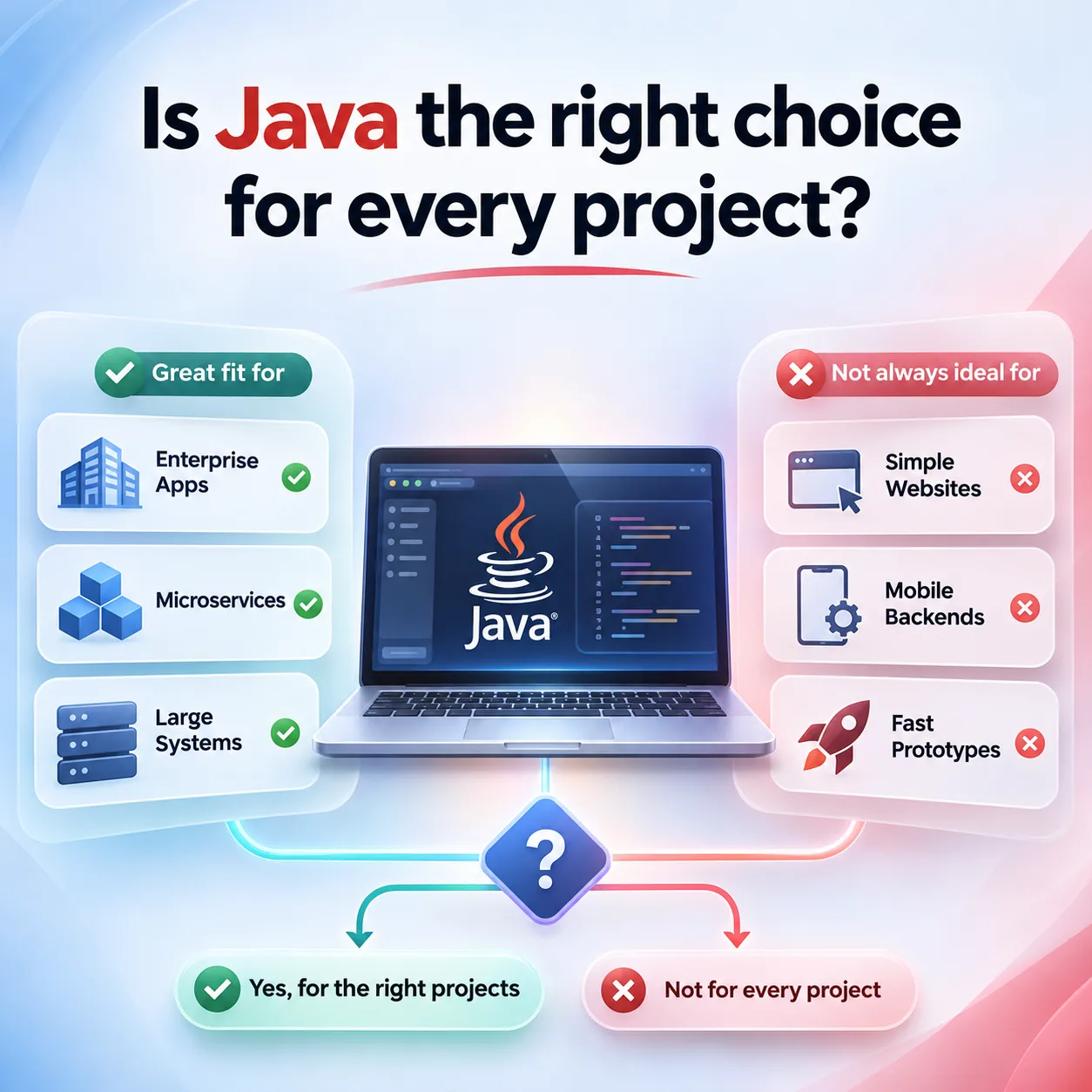
Is Java the right choice for every project?
No. Java is a strong option for applications that need substantial business logic, integrations, long-term maintainability, enterprise tooling or a mature JVM ecosystem. A simple marketing website or basic content site may be better served by a CMS or low-code platform. For smaller custom web applications, other stacks may also be more economical. The architecture should follow the product requirement, not the technology label.
Why businesses choose Java
Explain business value without absolute claims.
Long-term platform maturity
Java has decades of production use, a large ecosystem and established tooling for building and operating business software over long lifecycles.
Enterprise ecosystem
Frameworks, libraries, databases, messaging platforms, testing tools and observability products give teams many mature options without requiring every capability to be built from scratch.
Strong JVM runtime
The JVM provides sophisticated runtime optimization, memory management, diagnostics and cross-platform execution. Application performance still depends on architecture, data access and engineering quality.
Team and tooling availability
Java remains widely used across enterprise engineering, making it easier for many organizations to hire, train and maintain teams over the lifetime of a system.
API and integration strength
Java is a practical foundation for integration-heavy systems, backend services, event-driven applications and APIs that coordinate multiple business systems.
Modern cloud deployment
Java applications can be built for containers, Kubernetes and cloud environments while retaining compatibility with conventional enterprise deployment models where required.
Frequently Asked Questions
What does a Java development company do?
A Java development company designs, builds, integrates, modernizes and supports software on the Java platform. Typical work includes enterprise applications, APIs, backend services, portals, integrations, microservices, JDK upgrades and long-term maintenance.
Is Java still a good choice for enterprise software in 2026?
Yes, Java remains widely used for enterprise and backend software because of its mature JVM, large ecosystem, tooling, long-term support options and suitability for integration-heavy systems. The right choice still depends on the product, team and operating environment.
What is the latest Java version?
As of October 2026, Java 27 is the latest Java SE release. Java 25 is the latest Long-Term Support release, making it an important baseline for organizations that prefer a longer support horizon.
What is the difference between Java 27 and Java 25 LTS?
Java 27 is the newest feature release, while Java 25 is the current LTS release. Enterprise teams often choose an LTS line for longer-lived production baselines, but the right target depends on support policy, framework compatibility and upgrade cadence.
Can you modernize an old Java application?
Yes. Modernization can include JDK/framework upgrades, dependency cleanup, automated testing, modularization, API extraction, database improvements, UI decoupling, containerization and staged replacement of high-risk components.
Do you build Java microservices?
Yes, when independent deployment, scaling or domain boundaries justify microservices. We do not recommend microservices by default because they add operational complexity; many products are better served by a well-structured modular application.
Do you provide Spring Boot development?
Yes. Spring Boot is a major part of modern Java backend development. Unity Infoway is structuring a dedicated Spring Boot Development service page for buyers specifically evaluating Spring Boot applications, APIs and microservices.
Address
412, 4th Floor, Radhe Infinity, Rakshashakti Circle, Kudasan, Gandhinagar – 382421.