
AI Development Company
Unity Infoway designs and develops AI-powered applications that connect leading language and multimodal models with your business data, software, APIs and workflows. We build RAG knowledge systems, AI agents, copilots, intelligent automation, document AI, conversational experiences and custom AI features with evaluation, security, observability and human controls designed in from the start.
Whether you are adding AI to an existing SaaS product, creating a private knowledge assistant, automating a multi-step business workflow or validating a new AI product idea, our team can help move the project from discovery and prototype to production deployment and continuous improvement.
What is AI development?
AI development is the process of designing software that uses machine-learning or generative-AI models to understand information, generate or transform content, retrieve knowledge, make predictions, call tools or support decisions. In modern business applications, the model is only one layer. Production AI also requires data pipelines, retrieval, permissions, prompts, APIs, evaluation, monitoring, security controls, user experience and integration with existing systems.
AI Development Services We Offer
Use service cards with a short outcome-led description. Avoid a generic list of model logos as the main proof of capability.
AI Strategy & Discovery
Identify high-value use cases, data dependencies, risk constraints, success metrics and the right implementation pattern before committing to a full build.
Generative AI Application Development
Build customer-facing or internal applications that use LLMs and multimodal models for generation, transformation, reasoning, search, analysis and workflow assistance.
RAG & Enterprise Knowledge Systems
Connect AI to private documents, policies, knowledge bases and structured data using retrieval, citations, access controls and measurable answer-quality evaluation.
AI Agent Development
Build agents that can plan, call approved tools, retrieve data, execute multi-step workflows and request human approval for sensitive or high-impact actions.
AI Copilot Development
Embed context-aware assistance inside CRM, ERP, SaaS, support, operations or internal applications without forcing users into a separate AI tool.
MCP Server & Client Development
Expose approved tools and data through Model Context Protocol servers, connect applications to MCP ecosystems and implement authorization, tool restrictions and auditability.
AI Chatbot & Conversational AI
Create support, sales, onboarding and internal-assistance experiences grounded in business data, with escalation and workflow integration.
Document AI & Intelligent Processing
Extract, classify, summarize, validate and route information from PDFs, forms, invoices, contracts, records and other business documents.
AI Workflow Automation
Combine deterministic software, APIs and AI judgment to reduce repetitive work while keeping approvals and exception handling explicit.
Multimodal, Voice & Vision AI
Build experiences that work with text, images, audio, documents or video where multimodal understanding creates real product value.
LLM Integration & Model Routing
Integrate OpenAI, Anthropic, Google or suitable open-weight models, with routing, fallbacks, cost controls and provider abstraction where appropriate.
AI Evaluation, Guardrails & LLMOps
Create evaluation sets, quality checks, traces, dashboards, security controls and operational feedback loops so AI quality can be measured after launch.
Discuss Your Business Software Requirements

What We Build with AI
Show concrete software outcomes instead of treating AI as an abstract technology category.
Private knowledge assistant
Employees search policies, SOPs, manuals, contracts or project documents and receive grounded answers with source references.
Customer support copilot
Draft replies, retrieve account context, suggest actions and escalate to human agents when confidence or policy requires it.
AI sales assistant
Summarize accounts, prepare outreach, answer product questions and surface next-step recommendations from CRM and knowledge data.
Document processing system
Read incoming PDFs or forms, extract structured fields, validate rules, route exceptions and update downstream systems.
Operations agent
Coordinate approved tasks across internal tools, APIs, ticketing systems, calendars or databases with explicit permissions.
AI search / discovery
Use semantic and hybrid retrieval to find relevant products, records, cases or content beyond exact keyword matching.
Product copilot
Embed AI directly inside SaaS or business software to explain data, draft content, generate reports or guide users through tasks.
Meeting intelligence
Transcribe, summarize, extract action items, answer questions over meeting history and connect outputs to workflow systems.
Generative AI & LLM application development
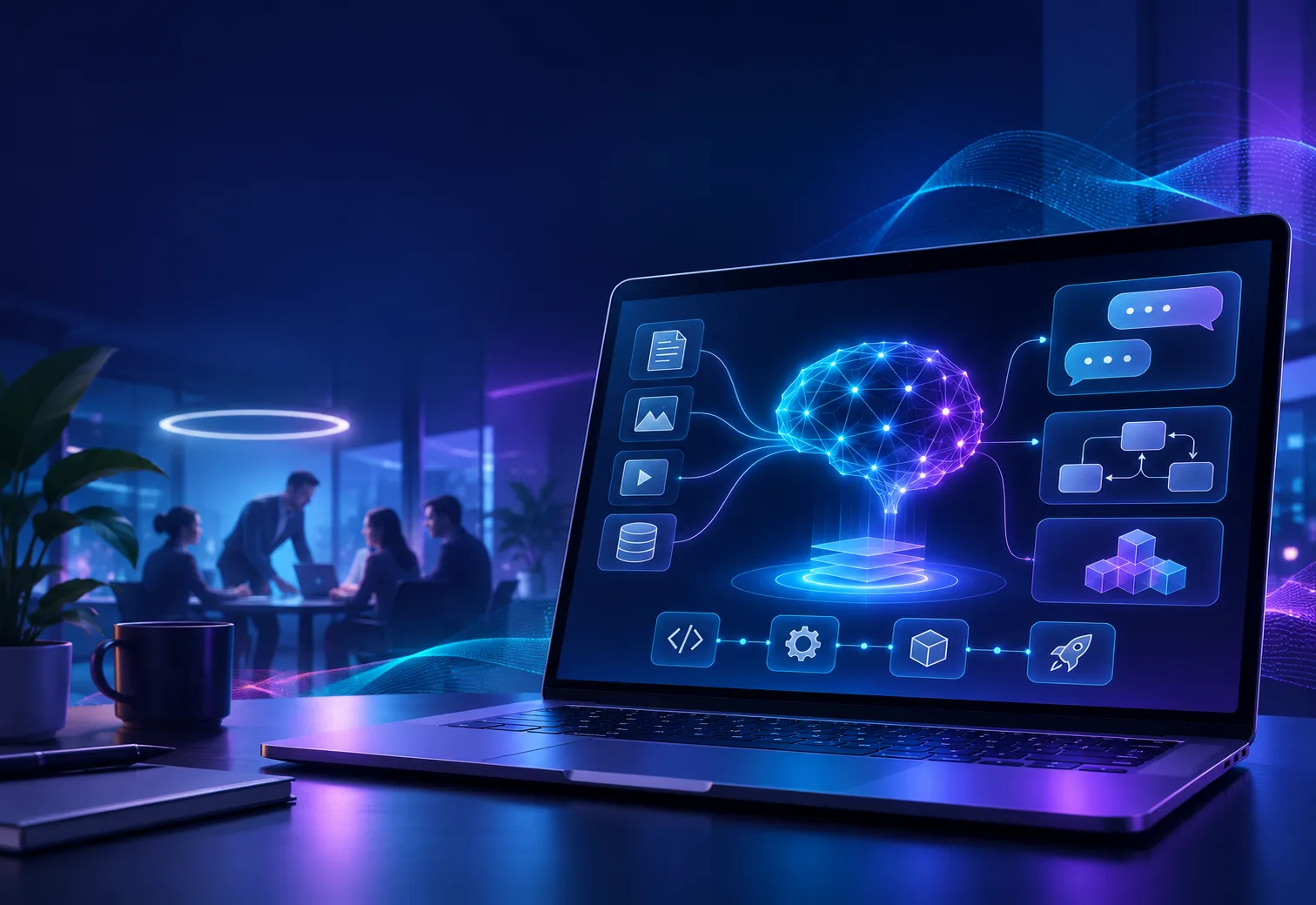
We build generative AI features and applications around defined user tasks, business context and measurable quality requirements. Depending on the use case, the system can generate or transform text, summarize records, classify content, extract structured data, create drafts, reason over context, call tools or combine multiple input types.
Evaluation, observability & AI quality engineering
This should be a core conversion section: serious buyers increasingly ask how AI quality will be measured.
Retrieval
Recall of relevant evidence, irrelevant-result rate, ranking quality, metadata-filter correctness.
Answer quality
Correctness, groundedness, completeness, citation accuracy, refusal/abstention behavior.
Agent tasks
Task completion, correct tool choice, unnecessary actions, approval compliance, recovery from tool failure.
Structured output
Schema validity, field-level extraction accuracy, normalization and business-rule validation.
Safety
Prompt-injection resistance, data leakage tests, permission violations, unsafe tool usage.
Operations
Latency, error rate, token/model cost, timeout rate, queue duration and provider failure rate.
Frequently Asked Questions
What does an AI development company do?
An AI development company designs and builds software that uses AI models, business data and integrations to perform defined tasks. Work can include generative AI applications, RAG systems, AI agents, copilots, chatbots, document processing, workflow automation, evaluation, security and production deployment.
What is the difference between generative AI, RAG and AI agents?
Generative AI creates or transforms content. RAG retrieves relevant private or current information and supplies it to the model before an answer is generated. An AI agent goes a step further by choosing and calling approved tools to complete a bounded multi-step task.
Can you build AI using our private company data?
Yes. A common approach is a RAG or application-integration architecture that retrieves only authorized company information at request time. The design should include access controls, data-retention rules, tenant isolation where needed, and clear model-provider data policies.
Do we need to train our own AI model??
Usually not. Many business use cases can be solved with a suitable foundation model plus good prompts, retrieval, tools and application logic. Fine-tuning or custom model training is considered only when evaluation shows that it is justified by the task and available data.
Can AI connect to our CRM, ERP or internal APIs?
Yes. AI applications can call approved APIs, query authorized databases or use integration layers such as function tools or MCP servers. The application should validate user permissions and business rules before any action is executed.
What is RAG and when should we use it?
Retrieval-augmented generation retrieves relevant evidence from your documents or data before generating an answer. Use it when information is private, changes frequently, is too large for a prompt, or should be cited back to a source.
What is an AI agent?
An AI agent is software that uses a model to decide which approved step or tool to use next in order to
complete a task. Production agents should have explicit tool permissions, stopping conditions, human
approval where needed and action traces for debugging and auditability.
Address
412, 4th Floor, Radhe Infinity, Rakshashakti Circle, Kudasan, Gandhinagar – 382421.