
IoT Development Company for Connected Products &Industrial Systems
- Home
- IT Services & Software Development Solutions
- IoT Development Company for Connected Products &Industrial Systems
IoT Development Company
Unity Infoway designs and develops IoT software that connects devices, machines and physical assets with secure cloud platforms, web and mobile applications, analytics and enterprise systems. We help businesses move from disconnected hardware and manual monitoring to reliable connected products and operational systems built for real-world scale.
Our IoT development services cover solution architecture, device-to-cloud communication, MQTT and API integration, industrial protocols, edge gateways, telemetry pipelines, device lifecycle workflows, dashboards, alerts, enterprise integrations, security and production operations.
IoT development services
Core commercial service section – ready to publish as cards or grouped content.
IoT Strategy & Solution Architecture
Define device, connectivity, edge, cloud, application, data and integration architecture around the business workflow, field environment, security requirements and expected fleet size.
Connected Product Software Development
Build the backend, APIs, portals and mobile/web experiences that turn connected hardware into a usable product for customers, operators and support teams.
IoT Platform & Cloud Backend Development
Develop secure ingestion, messaging, rules, storage, command workflows, APIs, user management and operational services for connected-device platforms.
Industrial IoT & OT Integration
Connect machines, sensors, PLC-adjacent systems and industrial data sources to applications and business systems using suitable gateways and protocols such as OPC UA, Modbus and MQTT.
IoT Device Management Workflows
Implement provisioning, device identity, registration, grouping, configuration, health status, remote commands, certificate/key workflows and lifecycle visibility.
IoT Dashboard & Application Development
Create operational dashboards, maps, timelines, alerts, reports and mobile/web interfaces for monitoring assets and acting on device data.
Edge & Gateway Application Development
Process, normalize, buffer or route data closer to devices when latency, intermittent connectivity, protocol translation or local decision-making requires an edge layer.
IoT API & Enterprise Integration
Connect IoT platforms with ERP, CRM, CMMS, MES, WMS, ticketing, notifications, billing, analytics and other business systems.
Telemetry & Event Pipeline Development
Design reliable event ingestion, routing, validation, time-series storage and downstream processing for device telemetry and operational events.
IoT Security Engineering
Build authentication, authorization, encryption, device identity, secrets/certificate handling, secure APIs, audit trails and security-focused lifecycle controls into the system.
OTA & Configuration Workflow Integration
Build the backend workflows, release controls, targeting, status visibility and audit trail needed to coordinate firmware/configuration updates with the device or firmware delivery mechanism.
IoT Modernization & Platform Migration
Upgrade legacy connected systems, replace brittle integrations, modernize APIs and data pipelines, improve observability, or migrate IoT workloads without losing operational continuity.
Discuss Your Business Software Requirements

Connected-system architecture
Use this section to show that IoT is a system – not a single app or protocol.
Device / Machine
Sensors, controllers, actuators, firmware and local device state
Connectivity
Wi-Fi, Ethernet, BLE, cellular, LoRaWAN, Thread/Matter or other field/network links
Edge / Gateway
Protocol translation, buffering, local rules, aggregation and offline resilience
Messaging / Ingestion
MQTT brokers, APIs, queues and event routing
Platform Services
Identity, device registry, configuration, commands, rules, fleet state and workflows
Data Layer
Time-series, relational/object storage, event history and analytics pipelines
Applications
Operations dashboard, customer portal, mobile app, alerts and support tools
Enterprise Integration
ERP, CRM, MES, WMS, CMMS, BI, billing and third-party APIs
Build the Software Backbone Behind Your Connected Devices
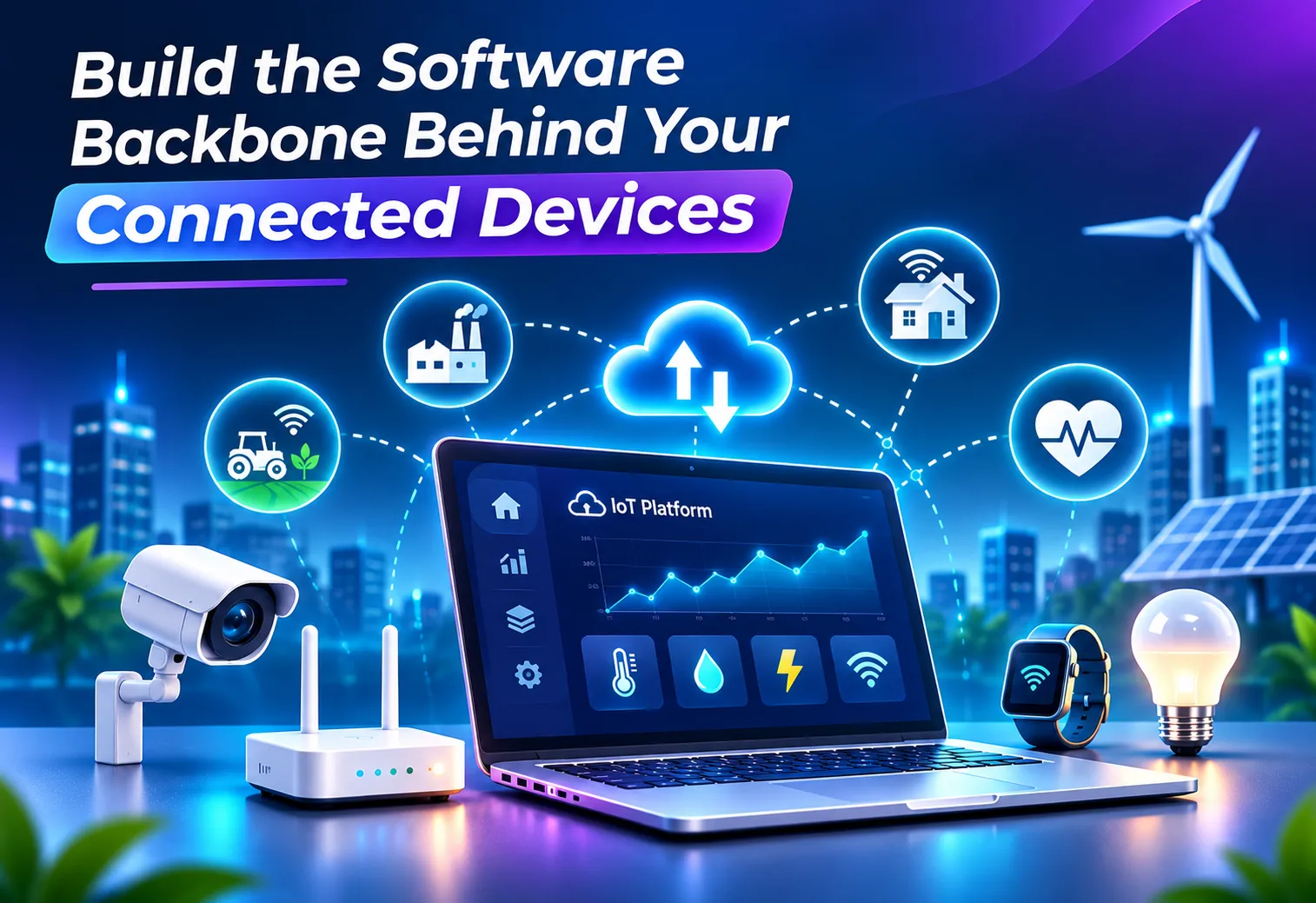
The cloud/backend layer determines whether an IoT product can move from a small pilot to reliable day-to-day operations. We design services that receive device events, maintain device state, route commands, enforce access rules, expose APIs and connect field data to the applications and business systems that need it.
Enterprise & third-party integrations
IoT value often appears only after device data enters existing business workflows.
ERP
Asset/customer mapping, service parts, orders, billing or operational status
CRM
Customer/device ownership, service events, alerts and account context
MES / Production
Machine status, production context and manufacturing workflows
CMMS / EAM
Condition-based maintenance requests, work orders and asset history
WMS / Logistics
Tracking, environmental telemetry, inventory or location events
Notifications
Email, SMS, push, chat or incident-routing workflows
Frequently Asked Questions
What is IoT development?
IoT development is the process of building software that connects physical devices or machines with digital systems. It can include device communication, gateways, cloud platforms, telemetry, device management, dashboards, mobile apps, APIs, alerts, analytics and enterprise integrations.
What IoT development services does Unity Infoway provide?
Unity Infoway focuses on IoT software and integration: architecture, device-to-cloud connectivity, MQTT/API integration, IoT backends, device lifecycle workflows, dashboards, edge/gateway applications, enterprise integrations, security and production operations.
Do you develop IoT hardware and firmware?
Our recommended website positioning is software/platform/integration focused. Hardware, PCB, RF and embedded-firmware services should be offered only when Unity Infoway has verified in-house capability or an explicitly scoped specialist partner.
Can you build an Industrial IoT platform?
Yes, the software scope can include gateway integration, OPC UA or MQTT connectivity, telemetry pipelines, dashboards, alert workflows and integration with MES, ERP, CMMS, WMS or analytics systems. PLC/control engineering should be scoped separately if required.
What protocols do you use for IoT?
Protocol choice depends on the device and environment. Common technologies include MQTT, HTTP/REST, WebSocket, OPC UA, Modbus through gateways, BLE, Wi-Fi, Ethernet, LoRaWAN, cellular and Matter/Thread for compatible smart-device scenarios.
Can you integrate existing devices with a new cloud platform?
Often yes. We first assess the device firmware, available protocols/APIs, identity model, payloads, gateway requirements and update constraints, then design a migration or integration path that minimizes disruption.
Address
412, 4th Floor, Radhe Infinity, Rakshashakti Circle, Kudasan, Gandhinagar – 382421.